
A canopy camper should make your truck more capable, not turn it into a safety hazard. Can all canopy campers fit all trucks? No. Some campers fit a wide range of pickups, but a safe, weather-tight, rattle-free installation depends on more than whether the camper is labeled “midsize” or “full-size.”
The right match starts with the truck bed. It also requires checking payload, mounting points, cab and tailgate clearance, and the roads you plan to travel. A gravel access road, a washboard forestry route, and a long highway run in crosswinds will reveal a poor fit quickly.
Can canopy campers fit trucks of different sizes?
Most canopy campers are designed around specific pickup-bed dimensions, and most are not universal. A camper made for a five-foot bed will not automatically fit a six-foot bed. A camper intended for a full-size truck may be too wide, heavy, or tall for a midsize pickup.
Even trucks with the same bed length can differ. A camper labeled for a Tacoma short box, for example, will not necessarily fit a Frontier short box from the same model year. Rail shape, bed width, tailgate design, and mounting points can all affect securement and sealing. And its an expensive and risky mistake to fit the wrong camper to the wrong truck.
Some designs do accommodate more truck models than others. The Yucca-Pac and Project M, along with a small number of North American made campers, can fit a broader range of pickups than many model-specific designs. A short-box Yucca-Pac built for a Frontier may be adaptable to another short-box quarter-ton truck with minimal modifications and the Yucca Pac is also built to be adaptable when truck manufacturers release a newer version of your truck think 2013 Tacoma to a 2026 Tacoma. That still requires the builder to check the truck and confirm that the changes preserve safe mounting and sealing. A five-foot camper, however, will not become a proper six-foot-bed camper just because the truck is close in size.
Truck model is only the starting point. Bed dimensions, rail profiles, tailgate designs, and payload ratings can change between trims and model years. A tonneau system, bed rack, utility rails, sport bar, or aftermarket bed cap can also interfere with installation.
Start with the truck bed, not the brochure
The physical fit is the first test. Measure the bed’s inside length at floor level, its width between the walls, the width across the rails, and the height from the bed floor to the rails. Check the rail shape too. Broad, molded, stepped, or composite rail caps may need specific mounting hardware or modification.
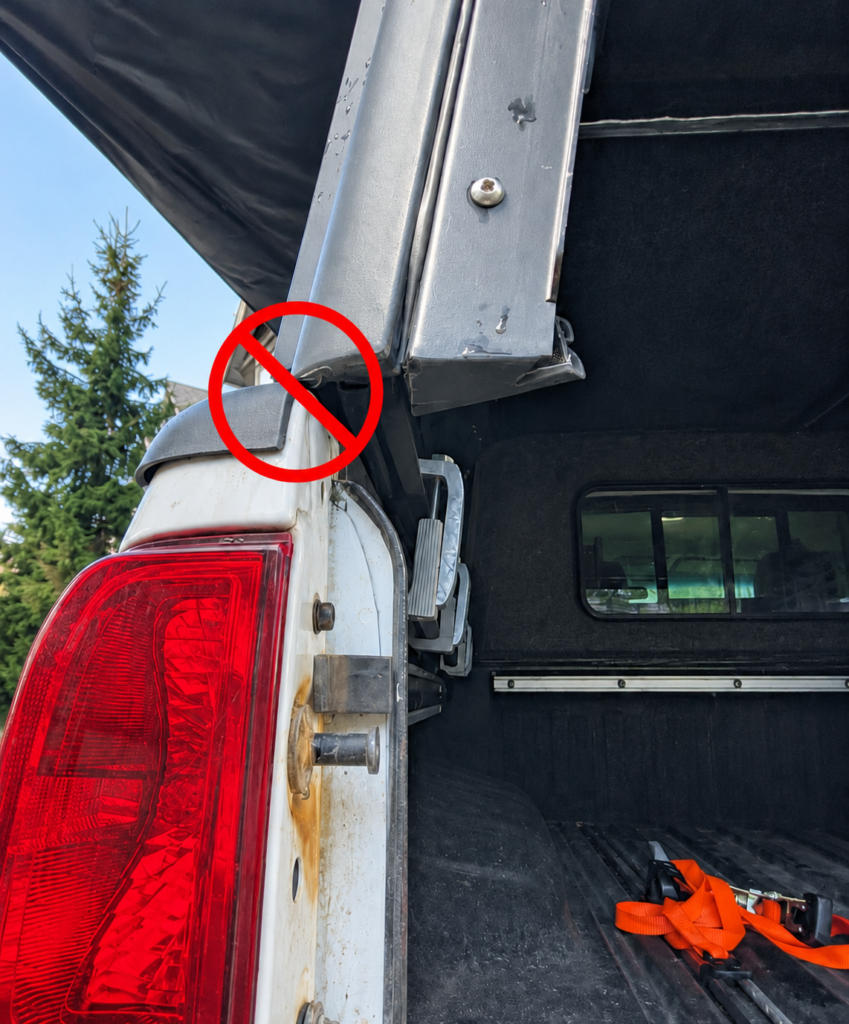
Check whether the camper extends over the cab, beyond the tailgate, or both. A cab-over section needs enough clearance to avoid contact when the truck frame flexes off-road. Even a small gap matters when the bed moves independently from the cab.
A proper installation should sit square and fully on the trucks bed rails, seal against weather, and use engineered mounting points designed for the loads involved. If the installation depends on improvised shims, piles of sealant, or hardware that does not suit the truck’s rails, stop and get fitment guidance before drilling or clamping anything down.
Payload is the number that protects your truck
A lightweight canopy camper can be much easier on a truck than a traditional slide-in camper, but “lightweight” does not mean weight no longer matters. Use the payload rating on the driver’s door-jamb sticker, not the maximum payload in a general truck advertisement.
Start with that rating and subtract the camper’s installed weight. Then account for passengers and everything else in the truck: drawers, accessories, a fridge, tools, recovery boards, batteries, a hitch rack, and cargo.
Water and fuel add up quickly. Water weighs about 8.3 pounds per gallon, and a full cooler can weigh more than expected. Two people traveling for several days can carry hundreds of pounds beyond the camper itself.
For example, a truck with a 1,400-pound payload and a 400-pound camper has room on paper. Add two adults, a dog, water, camping gear, a fridge, and a bike rack, and the remaining capacity shrinks. That does not automatically make the setup unsafe, but it shows why a realistic weight plan matters.
Check axle ratings and tire capacity as well. Gear loaded near the tailgate affects rear-axle load and handling more than the same gear stored forward. A well-designed camper can help keep storage low and centralized, but the owner still decides what goes inside.
Do your research—and ask who actually built it
Fit is not only a measurement problem. It is also a question of who understands the product, how it is mounted, and who will help when something goes wrong.
There is nothing automatically wrong with an imported camper or an affordable one. The problem is when a seller misrepresents where a camper is made, claims to build a product they only resell, cannot explain its mounting system, or leaves customers without useful warranty support.
At Blindman Overland, we are consistently encountering cases where customers say they were told a camper was built by popular resellers, then later learning it was clearing customs and at that point you have already paid a deposit.
We have also heard from customers who struggled to get clear answers about fitment, warranty concerns, or build progress. Those experiences are why buyers should ask direct questions and for evidence before putting down a deposit.
Ask the seller:
- Where is this specific camper manufactured?
- Who designed and built it?
- What trucks and model years has it been fitted to?
- What mounting hardware is required for your truck?
- Who handles warranty claims, and where are replacement parts sourced?
- Can they show build records, installation examples, or other evidence for their claims?
Look for clear answers. If the seller avoids saying where the camper is made, cannot provide techincal data, or cannot explain how it mounts to your truck, take that seriously. If the camper is supposedly being built locally but the seller says it is delayed at customs, ask for an explanation in writing.
Check Google reviews and marketplace listings such as Facebook Marketplace and Kijiji. If you see several used campers from the brand, ask their owners why they are selling and whether they had fitment or support problems. One unhappy customer does not tell the whole story; a pattern deserves attention.
A lower-priced imported camper may be the right choice for some buyers. But know what you are buying, who stands behind it, and what support is available after the sale. A seller who knows the product should be able to explain its limits and show how it is secured.
More storage, insulation, roof capacity, and accessories can add capability, but they also add weight, height, cost, and complexity. The right camper is not necessarily the one with the longest feature list. It is the one that gives you the shelter and security you need while keeping the truck useful.
Low weight matters especially on midsize pickups and off-road routes. It leaves more payload for people and supplies, lowers strain on brakes and tires, and helps keep daily driving manageable.
Do not ignore height, handling, and clearance
A camper changes your truck’s center of gravity and overall height. Regardless of how light your payload is your suspensions life cycle will be impacted with a constant load above the vehicles typical weight so adding additional rear suspension helper springs,or bump stops is always encouraged and depending on the truck could be neceary, this is true for campers, tool boxex, slip tanks alike.
Measure garage doors, carports, parkades, ferry restrictions, and low branches along routes you use. Awnings, solar panels, traction boards, and roof boxes add height too.
Handling changes are normal, particularly in wind. Set tire pressures for the loaded vehicle, use tires with adequate load capacity, and keep the suspension in good condition. Springs, shocks, or airbags may help a truck that carries a steady load, but they do not increase the payload rating on the door sticker.
Check departure angle, rear overhang, and roof clearance off-road. A canopy camper keeps more weight low than a rooftop tent and avoids the bulk of a heavy slide-in, but it does not make a stock truck invincible. Choose routes that suit the whole vehicle, not just its four-wheel-drive badge.
Installation details determine long-term fit
A camper can fit on day one and still cause trouble after a season of vibration if it is installed incorrectly. Mounting hardware, torque checks, quality bed seal, and wiring protection are all part of fitment.
If the camper has interior lighting, a heater, solar input, a battery system, or exterior lights, confirm how the wiring will enter the bed and connect to the vehicle. Wiring should be properly fused, protected from abrasion, and routed away from heat, moving parts, and sharp edges.
Recheck mounts after the first drive, after the first rough road, and regularly afterward. Look for shifted seals, loose clamps, bed-rail wear, and any contact between the camper and cab. A few minutes of inspection can help prevent truck damage or a trip cut short by water intrusion.
Blindman Overland treats fitment as part of the build, not an afterthought. A lightweight Yucca-Pac canopy camper can give the right truck secure cargo space, an elevated sleeping area, and all-season shelter without the weight of a conventional RV-sized setup. The truck, intended load, and mounting details still need to be confirmed before installation.
Bring the exact truck year, trim, bed length, payload sticker, current accessories, and a realistic gear list to the conversation. Then ask the seller to explain how the camper will fit and how it will be secured. If they cannot answer clearly, keep looking.