
A truck that can carry bikes, recovery gear, hunting equipment, and a dry place to sleep changes the way you travel. Canadian made pop up truck campers are built for owners who want that freedom without turning a pickup into a heavyweight RV – or leaving expensive gear exposed under a tarp.
For mountain roads, prairie two-tracks, trailhead overnights, and long runs south toward the desert, the right camper needs to do more than look capable in a parking lot. It needs to stay light, resist weather, protect your equipment, and set up quickly when the temperature drops or the wind starts moving.
Why Canadian Made Pop Up Truck Campers Fit Real Travel
A pop-up truck camper gives you a low travel profile and standing room when camp is set. That is the basic appeal. But the best designs go further by combining sleeping space with enclosed storage, a durable shell, and a weight that leaves your truck useful for the road you actually plan to drive.
Canadian-built campers are shaped by conditions that do not offer much forgiveness. Cold shoulder seasons, wet snow, washboard roads, gravel spray, and long distances between services put pressure on every hinge, seal, latch, and panel. A camper intended for those conditions should not rely on decorative finishes or a bulky interior to prove its value. It should be simple where it needs to be simple, strong where it takes abuse, and easy to live with after a muddy day outside.
For many truck owners, the better question is not, “How much camper can I put in the bed?” It is, “How much capability can I carry without compromising the truck?” That distinction matters when you drive a midsize pickup, haul a trailer occasionally, or need your rig to remain manageable on narrow forest roads.
Low Weight Is More Than a Spec Sheet Number
Weight affects braking, handling, fuel use, tire choice, suspension wear, and confidence on uneven ground. A conventional slide-in camper can add thousands of pounds before water, batteries, food, and gear enter the picture. That may work for a heavy-duty truck on maintained roads, but it is not the right answer for every traveler.
A lightweight pop-up platform in the roughly 300- to 450-pound range gives truck owners more options. It can preserve payload for people and equipment, reduce top-heavy handling, and make it easier to build a capable overland rig without immediately requiring major suspension changes. It also makes a canopy-style camper practical for more trucks, including many midsize platforms.
Low weight does involve trade-offs. You may not get a built-in bathroom, a large freshwater tank, or the residential-style interior found in a large slide-in. For self-sufficient travelers who prioritize mobility, outdoor cooking, and organized cargo space, that is often a fair trade. The truck stays a truck. The campsite becomes your living room.
Pay Attention to Payload, Not Just Camper Weight
A camper’s dry weight is only the starting point. Add bedding, a fridge, tools, traction boards, a battery system, recovery equipment, dogs, food, and passengers, and the numbers move fast. Check the payload sticker on your specific truck, account for the weight already added through accessories, and consider axle ratings and tire capacity.
A well-matched lightweight camper does not eliminate the need to plan. It gives you more room to plan intelligently. That is especially valuable for owners who use one truck for weekday work, weekend travel, and longer expeditions.
Materials Matter When the Road Gets Rough
Not every pop-up camper is built around the same structure. Wood-framed construction can feel familiar and may lower the purchase price, but moisture intrusion is a long-term risk when a camper sees wet climates, freeze-thaw cycles, and regular vibration. Once water finds a path into a wood-based structure, repairs can become expensive and difficult to diagnose.
A no-wood composite structure with a formed aluminum exoskeleton takes a different approach. Aluminum adds a durable outer layer that stands up to branches, gravel, and travel wear, while composite construction removes the rot-prone framing found in many traditional campers. The result is a shell designed for repeated use, not just occasional fair-weather weekends.
The pop-up section deserves equal attention. Roof lift systems, tent materials, window placement, insulation options, and seals all affect how a camper performs in wind and cold. A pop-up will never behave exactly like a hard-sided cabin in severe winter weather. Still, a properly designed all-season system can extend the usable season dramatically when paired with the right sleeping setup, heat source, and realistic expectations.
Secure Storage Is the Difference Between Camping and Living Out of Totes
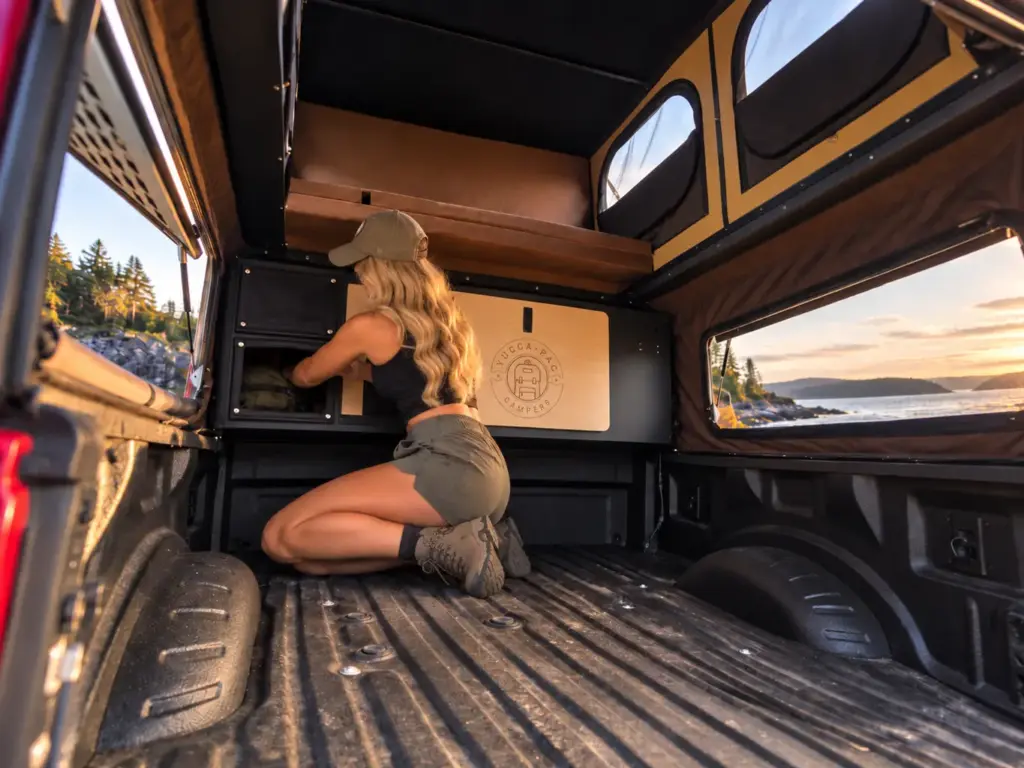
A rooftop tent solves the sleeping problem, but it does little for cargo security. A standard truck cap protects gear from rain, yet it does not create an elevated sleeping platform or the camp-ready experience many travelers want. A pop-up canopy camper sits in the useful middle ground: secure storage below, sleeping space above, and a compact profile while moving.
That layout matters if you travel with expensive equipment. Bikes, climbing gear, cameras, rifles, fishing tackle, recovery tools, and jobsite equipment all deserve more protection than an exposed truck bed provides. Anti-intrusion construction, strong locking points, and enclosed side access create a more secure system for travel days, fuel stops, and trailhead parking.
The best storage layout is not necessarily the one with the most compartments. It is the one that lets you reach essential gear without unloading half the truck. Think about how you pack: dirty equipment, dry bedding, cooking kit, recovery gear, and daily-use items should have distinct places. A camper that supports that organization saves time at camp and reduces frustration when weather turns.
Choose a Sleeping Layout Around How You Actually Travel
Pop-up campers generally offer different sleeping arrangements, including forward and rear sleeping areas. Neither is automatically better. A forward sleeping setup may suit owners who want a certain cargo layout or vehicle profile, while a rear sleeping area can make sense for others based on access and preferred use of the bed space.
Before choosing, consider how many people sleep in the camper, whether you travel with pets, and how often you need to access stored gear late at night. Also think about camp setup. If you arrive after dark, a straightforward lift system and a familiar interior layout matter more than flashy features you rarely use.
Blindman Overland’s Canadian-made Yucca-Pac is built around this practical balance: lightweight canopy utility, elevated sleeping, protected cargo capacity, and a tough aluminum-and-composite structure for four-season use. It is the kind of design that makes sense for owners who would rather spend their budget on travel and equipment than carry unnecessary bulk.
What to Check Before You Buy
A strong camper is only as useful as its fit on your truck. Confirm bed length compatibility, mounting method, cab clearance, and the effect of the finished build on payload. If you run a tonneau cover, bed rack, auxiliary fuel setup, or other accessories, discuss those parts before installation instead of trying to solve conflicts afterward.
Ask how the camper is inspected before delivery and who handles service when you need adjustments, repairs, wiring work, or accessory installation. A camper is not a disposable add-on. It will see vibration, weather, loading cycles, and the occasional mistake on a tight trail. Access to knowledgeable installation and support is part of the ownership equation.
It is also worth being honest about your travel style. If most of your trips happen at full-service RV parks with a family of five, a lightweight pop-up may feel too minimal. If you travel as a solo adventurer or couple, spend your days outside, and want to sleep securely wherever the road ends, the compact approach can be hard to beat.
A well-built pop-up camper should make spontaneous travel easier, not add another complicated system to manage. Load the truck, secure the gear, point it toward the next trailhead, and keep moving when the road gets interesting.